Cart
0
You may also like



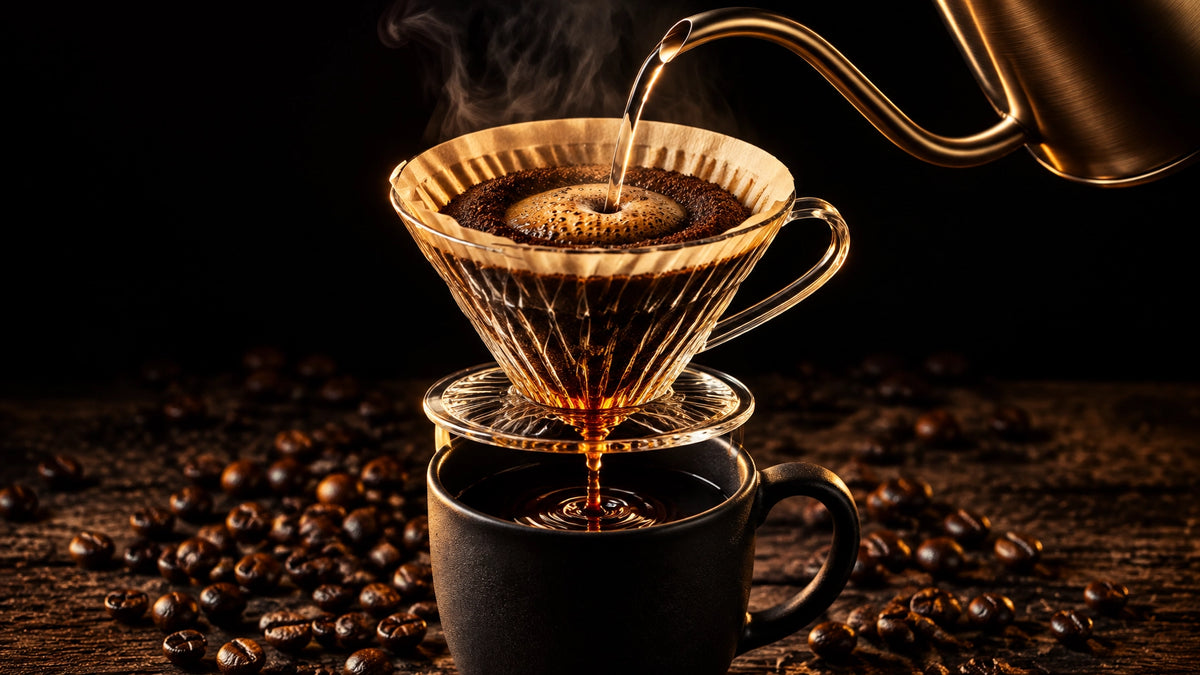
Pour-over coffee does not need a ritual, a specialized vocabulary, or fifteen separate pour stages.
It needs control.
Use a reliable dose. Keep the ratio consistent. Grind fresh. Pour with intent. Then adjust one variable at a time.
That is the entire game.
A V60 or Chemex gives you direct control over extraction, which makes the method ideal for fresh roasted coffee beans and expressive single origin coffee beans. But control only helps when the process is repeatable.
Use this four-minute framework as your baseline.
Keep the setup lean:
A gooseneck kettle helps you control flow. A scale eliminates guesswork. A burr grinder gives you a more consistent particle size than a blade grinder.
You do not need the most expensive version of any of these tools. You need equipment that behaves consistently.
That matters more.

Start with this recipe for a single cup:
For a Chemex, scale up to 20 grams of coffee and 320 grams of water. Keep the same 1:16 ratio, but use a slightly coarser grind and expect a slower drawdown because the filter is thicker.
Measure by weight. Volume measurements are too inconsistent for dialing in coffee.
Place the filter in the brewer and rinse it thoroughly with hot water. This removes paper flavor and preheats the brewer.
Discard the rinse water.
Add 15 grams of freshly ground coffee. Give the brewer a gentle shake to flatten the coffee bed.
Start the timer.
Pour approximately 30 grams of water. That is about twice the weight of the coffee.
Saturate the grounds evenly. Start in the center and work outward with controlled circles. Avoid blasting the paper filter directly.
Let the coffee rest for 30–45 seconds.
The bloom allows trapped carbon dioxide to escape. Fresh coffee releases more gas, so this step matters even more when working with coffee that was roasted to order.
Do not rush it.
Pour slowly and steadily until the scale reaches approximately 150 grams.
Keep the stream controlled. Use small concentric circles. Stay mostly over the coffee bed instead of pouring aggressively against the sides of the filter.
Your goal is even saturation and moderate agitation. You are not trying to create turbulence for its own sake.
When the water level drops but the coffee bed remains covered, begin the final pour.
Bring the total water weight to 240 grams.
Keep the bed level. Avoid dramatic pouring patterns. Consistency beats performance.
Let the water drain completely.
A V60 should typically finish somewhere around three to four minutes with this dose. A Chemex may take longer, especially with a large brew or a slower filter. Do not chase an arbitrary time if the cup tastes balanced.
Swirl the finished coffee gently. Let it cool for a minute or two, then taste it.
Hot coffee hides detail. A short rest gives you a more accurate read on sweetness, acidity, body, and finish.
Grind size controls how quickly water moves through the coffee and how much surface area the water can access.
For a V60, start around medium-fine. The grounds should look finer than sand but not powdery.
For a Chemex, go slightly coarser. The thicker filter needs more room for water to move through the coffee bed.
Use brew time as a signal, not a verdict:
Do not change the grind, ratio, and temperature at the same time. That destroys useful information.
Change one variable. Brew again. Compare.
The principle is simple: finer grinds generally increase extraction; coarser grinds generally reduce it.
The 1:16 ratio is a strong starting point because it produces a clear cup with enough concentration to retain sweetness and structure.
With 15 grams of coffee:
Use ratio when the coffee tastes too strong, too thin, or out of balance even after the grind is close.
If the brew tastes intense but not harsh, add water. Move from 1:16 to 1:17.
If the brew tastes thin but properly extracted, use less water. Move from 1:16 to 1:15.
Do not use ratio to compensate for an obviously clogged or excessively fast brew. Fix the grind first.
Water around 200°F sits inside the practical brewing range for most specialty coffee.
Temperature affects extraction, but it is not the first lever to pull. Start near 200°F and keep it stable.
Move hotter, toward 203–205°F, when the cup tastes underdeveloped, sharp, or hollow despite a reasonable grind and brew time.
Move cooler, toward 195–198°F, when the cup tastes harsh, roasty, or excessively bitter and the grind is already appropriate.
Avoid turning temperature into a superstition. The coffee does not know whether your kettle stopped at a perfectly specific number. It responds to heat, contact time, water chemistry, grind, and agitation working together.
Keep the process repeatable first.
Sourness usually signals under-extraction, especially when it comes with a fast drawdown or thin body.
Make these adjustments in order:
Do not automatically blame the coffee. Bright acidity is not the same as sourness.
A well-brewed light roast can taste citrusy, floral, or sparkling. Under-extracted coffee tastes sharp, unfinished, and empty through the finish.
Bitterness, astringency, and a drying finish usually point toward over-extraction or uneven extraction.
Make these adjustments:
A bitter cup is not always over-extracted across the entire coffee bed. Poor pouring can create both under-extracted and over-extracted pockets at once. That produces a cup that tastes sour, bitter, and flat in the same sip.
Keep your pours even. Eliminate unnecessary movement.
Pour-over exposes the coffee.
That makes it unforgiving with stale or poorly roasted beans. It also makes it highly rewarding with fresh, high-quality coffee.
Grinding whole bean coffee immediately before brewing preserves aromatic compounds that disappear quickly after grinding. Freshly roasted beans also respond more clearly to the bloom and controlled water flow.
At Shift Coffee, batches are roasted to order right before shipping. That gives you a stronger starting point than coffee that has been sitting in a warehouse for months.
Use that freshness properly:

Some origins make the value of pour-over obvious.
Nyota is a light roast from Othaya, Nyeri County, grown at approximately 1,700–1,890 meters. Its profile leads with orange and lemon, followed by floral lift and a clean finish.
Brew it in a V60 when you want clarity and defined acidity. Start at 200°F with a 1:16 ratio. If the cup tastes sharp, grind slightly finer before raising the temperature.
Uhuru comes from Tanzania’s Mbeya Region and is roasted medium-light. Pear and strawberry notes lead into jasmine and a clean finish.
A V60 highlights its structure. A Chemex emphasizes its lighter body and clarity. Use a slightly coarser grind for the Chemex and keep the pour steady through the middle of the brew.
Explore more Global Selects when you want to compare how origin, roast, and processing change inside the same brewing framework.
Pour-over is not difficult. It is simply visible.
The method shows you exactly what your grind, water, dose, and pouring are doing. That makes it easier to improve, but only if you resist unnecessary complexity.
Start here:
Then taste.
Adjust grind first. Ratio second. Temperature third.
Build a repeatable cup before chasing a perfect one. That is how fresh roasted coffee beans become a better daily brew instead of another complicated morning project.
For more brewing guidance, use Shift Coffee’s How To have the best coffee experience page, or browse the full coffee collection.
Brewing ratios, temperature ranges, bloom guidance, and extraction adjustments are informed by Coffee Ad Astra’s technical guide to brewing better coffee with a V60.

